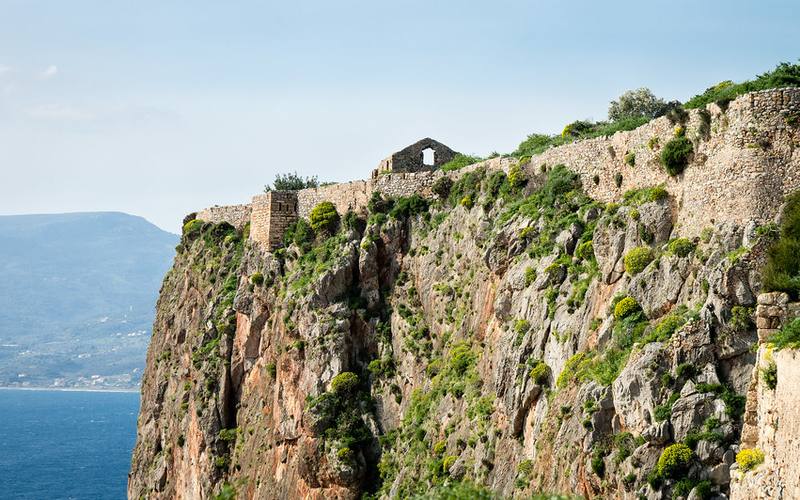
If one region of Greece concentrates more mythology, Byzantine grandeur, and raw coastal beauty than anywhere else, it is the Peloponnese. Webmag has been covering Greek travel for years, and the Peloponnese keeps appearing at the top of editors’ recommendations — not because it is fashionable, but because it is genuinely extraordinary. Hanging off the Greek mainland like a great oak leaf, connected to the rest of the country only by the Corinth Canal and the dramatic Rio-Antirrio bridge, this peninsula packs in Mycenae, Olympia, Nafplio, the Mani tower-villages, and a coastline that rivals any island.
This guide is for the traveller who wants more than a beach resort. It covers the ancient sites that still give you goosebumps, the mountain roads that open onto forgotten villages, the harbours where fishing boats unload at dawn, and the practical details — transport, seasons, food — that make the difference between a smooth trip and a stressful one. The Peloponnese rewards slow travel above all else.
Why the Peloponnese Deserves More Than a Day Trip
Most tourists encounter the Peloponnese as a day excursion from Athens: two hours to Corinth, a quick photo at the canal, then back. That is a shame, because the region’s character only reveals itself when you stay long enough to see a sunset over the Mani, eat dinner with locals in Kalamata, or walk the olive-shaded paths of Arcadia. Budget at minimum five nights, seven if you can; the distances between sites are greater than they look on a map, and the winding roads through the Taygetos range take twice as long as the satnav predicts.
Getting There and Around
From Athens, the most comfortable approach is the E65/A8 motorway via Corinth — about ninety minutes to the isthmus. Buses from Athens KTEL terminal B (Kifissos) run frequently to Nafplio, Tripoli, Kalamata, and Patras. There is no domestic airport useful for most Peloponnese destinations, so driving or bussing is the real choice. Renting a car in Athens or Corinth is the practical option: many of the best sites — the castle of Mystras, the Mani tower villages, the temple of Bassae — are unreachable by public transport. Roads are generally in good condition on the main arteries; secondary mountain routes can be narrow but are well-signposted.
The Corinth Canal: A Dramatic First Impression
Crossing from the mainland into the Peloponnese, the Corinth Canal stops you in your tracks even if you have seen photographs. Cut through solid limestone in the late nineteenth century, it is 6.3 kilometres long and only 25 metres wide — too narrow for modern cargo ships, which made it economically redundant almost immediately, but too spectacular to demolish. Stop at the old bridge for the classic vertigo-inducing view down into the blue stripe of water 79 metres below. Ancient Corinth, a few kilometres inland, is worth half a day: the Temple of Apollo, the Roman agora, and the excellent archaeological museum trace the city that Paul of Tarsus addressed in his famous letters.
Mycenae: Walking Into the Bronze Age
An hour south of Corinth, Mycenae is the site where Heinrich Schliemann dug up golden masks in 1876 and cabled back to the Greek king that he had gazed upon the face of Agamemnon. The archaeology is more nuanced than that telegram, but the atmosphere is undimmed. The Lion Gate — Europe’s oldest monumental sculpture — frames the entrance to a citadel that dominated the Aegean world for three centuries. Beyond it, the Treasury of Atreus (also called the Tomb of Agamemnon) is a corbelled tholos tomb so perfectly engineered that it stood for three thousand years without mortar. Come early morning before the tour buses arrive; the site at 8 a.m. on a spring day, with mist still in the valley below, is close to mystical.
Nafplio: The Prettiest Town in Greece
Nafplio is the city that appears in almost every serious Greek travel article, and yet it never feels overrun because it has kept its scale. Greece’s first modern capital after independence, it wears its Venetian, Ottoman, and neoclassical layers comfortably together. The old town is a grid of narrow streets rising to the Palamidi fortress — 999 steps, worth every one for the view across the Argolic Gulf. Below, the harbour fills with yachts and small ferries, and the cafe-lined main square, Syntagma, is a good spot to try the local almond biscuits called amygdalota. Nafplio makes an ideal base for the northeast Peloponnese: Mycenae, Tiryns, Argos, and Epidaurus are all within forty minutes.
Epidaurus: Theatre and Healing
The theatre of Epidaurus is simply the finest ancient Greek theatre surviving anywhere. Built in the fourth century BC by the architect Polykleitos the Younger, it seats fourteen thousand and achieves acoustic perfection that no modern engineer has been able to fully explain. A coin dropped on the orchestra stone at the centre is audible in the top row. In summer, the Athens-Epidaurus Festival brings tragedy and comedy back to the original venue; watching Sophocles performed here, under the stars, in the theatre built for exactly this purpose, ranks among the great cultural experiences Greece offers. The sanctuary of Asklepios around it — ancient Greece’s most important healing centre — deserves more attention than it usually receives.
Mystras: The Byzantine Ghost City
Webmag has described Mystras as one of the most atmospheric sites in all of Greece, and the description is accurate. A UNESCO World Heritage site, it is a fortified Byzantine city on the slopes of the Taygetos range above Sparta, abandoned in the nineteenth century and left largely intact. Frescoed churches, the ruins of a palace, terraced streets half-reclaimed by vegetation, and the great castle of the Despotate of Morea above it all — Mystras is the kind of place where the silence feels inhabited. Bring good walking shoes; the site involves a serious uphill climb. The nearby modern town of Sparta is unremarkable but useful for accommodation and supplies.
The Mani Peninsula: Towers, Caves, and Hard Beauty
The Mani is the middle finger of the Peloponnese’s three southern peninsulas, and the most dramatic. Its landscape is lunar: bone-dry limestone ridges, sparse scrub, the deep blue of two seas on either side, and village after village of medieval tower-houses built by clans who fought each other and every outside power for centuries. Areopoli is the region’s main town, named for Ares, the god of war — appropriately enough. The Diros Caves near Pyrgos Dirou are among Europe’s most spectacular show caves, their stalactite chambers accessible by flat-bottomed boat. The road south to the Cape Matapan (Tainaro), the southernmost point of mainland Europe and mythological entrance to the underworld, ends at a lighthouse beside scattered ruins of a Poseidon sanctuary.
Kalamata and the Messenian Coast
Kalamata’s waterfront is lively and the old town retains a Frankish castle and Byzantine quarter. The Messenian Gulf beaches — Petalidi, Koroni, Stoupa — are among the Peloponnese’s finest: long sandy stretches, clear water, real tavernas, and little of the package-holiday infrastructure that crowds other Greek coasts in August.
Ancient Messene: The Forgotten Giant
Most visitors skip Ancient Messene for Olympia or Mystras. Founded in 369 BC, it has some of antiquity’s best-preserved circuit walls, with towers still standing to full height. The excavated core includes a stadium, an odeon, and a sanctuary of Asklepios — all well-maintained and almost never crowded. Allow two to three hours and expect to have the site largely to yourself.
Olympia: Birthplace of the Games
No Peloponnese itinerary omits Olympia. The sanctuary where athletes competed every four years from 776 BC is now a ruin, but an evocative one — fallen columns of the Temple of Zeus, the starting line worn smooth by ancient feet, the Philippeion. The on-site museum is exceptional: sculpted pediments, the Hermes of Praxiteles, and a collection of bronzes that fill in what the sanctuary once looked like. Book tickets online; Olympia draws crowds and early morning arrival pays off.
Arcadia and Hidden Corners
The Argolid and inland Arcadia repay detours. The Venetian fortress of Karytaina above the Alfios gorge appears on the old 5,000-drachma note. Dimitsana, a mountain village above Tripoli, has a water-mill museum and views over the Loussios gorge. The gorge hike between the monastery of Prodromos and ancient Gortys is a fine half-day walk.
Food and Drink: What to Order
Peloponnese cooking centres on olive oil, lamb, and extraordinary local produce. Kalamata olives and Laconian olive oil are internationally traded specialities. In the Mani, try pasteli (sesame-honey bars) and slow-braised goat. Nafplio serves fresh Argolic Gulf seafood. The Nemea appellation produces deep, tannic reds from the Agiorgitiko grape that deserve far more attention than they receive outside Greece.
Planning Your Route: A Suggested Arc
The most logical route follows a clockwise loop from Athens: Corinth and Nafplio first, then Mycenae and Epidaurus as day trips from Nafplio, then south to Sparta and Mystras, west through the Mani to Kalamata, northwest to Ancient Messene and Olympia, and back via Patras. Seven to eight days covers this without feeling rushed; add time anywhere the landscape makes you want to stop.
Island Connections from the Peloponnese
The Peloponnese coast connects easily to several islands. From Gythio or the small port of Neapolis, ferries reach Kythira, the island that belongs geographically to the Peloponnese but administratively to the Ionian island group — a quiet, unspoilt place with Venetian fortresses and empty beaches. From Ermioni or Porto Heli on the east coast, hydrofoils reach Hydra in under an hour — the car-free island of white mansions and donkey paths that remains one of the most distinctive places in the Aegean. From Patras, ferries cross to the Ionian islands or to Italy for those building a longer European itinerary.
Extending Your Trip: Greek Island Combinations
After the Peloponnese, many travellers turn their attention to the Aegean. Webmag covers the full range of Greek island options. If you enjoy combining mainland history with island variety, the concept of island hopping across the Greek archipelago is the natural extension of a Peloponnese road trip. The Dodecanese offer a very different character from the Peloponnese — lighter, more Mediterranean, full of crusader castles and Ottoman mosques alongside ancient sites. Kos is a good base for that group, with easy ferry connections across the chain. For something wilder and more authentic, Webmag’s coverage of Ikaria documents an island where life moves at its own pace entirely, famous for the longevity of its inhabitants and a landscape that rewards walkers and independent travellers.
Travel Checklist: Before You Go
- Book Epidaurus tickets in advance if visiting during the Athens-Epidaurus Festival (July-August)
- Reserve a rental car before arrival — availability drops sharply in peak season
- Download offline maps for the Mani and Arcadia, where mobile data can be patchy
- Pack walking shoes with ankle support for Mycenae, Mystras, and the Loussios Gorge
- Carry cash; many rural villages and smaller sites are cash-only
- Check ferry schedules to Kythira and Hydra in advance — frequency varies sharply by season
- Allow extra time on mountain roads; the satnav estimate is always optimistic
Frequently Asked Questions
What is the best time of year to visit the Peloponnese?
Late April through June and September through October are ideal. The weather is warm but not exhausting, the archaeological sites are less crowded, wildflowers are out in spring, and the sea is still warm enough to swim in October. July and August are hot (often above 35°C inland) and more crowded at major sites; if you visit in high summer, prioritise early morning visits to Mycenae, Olympia, and Mystras, and retreat to the coast in the afternoon.
How many days do I need for the Peloponnese?
Five days is the practical minimum to cover Nafplio, Mycenae, Epidaurus, Mystras, and one coastal area. Seven days allows you to add the Mani, Ancient Messene, and Olympia without feeling rushed. Ten days lets you explore properly, with time for the Arcadian mountain villages, some hiking, and lingering over meals in places you might otherwise just pass through.
Is it worth renting a car, or can I manage by bus?
A car is strongly recommended. The intercity KTEL buses are reliable between major towns (Nafplio, Kalamata, Tripoli, Patras, Corinth), but they do not serve the Mani villages, the Arcadian gorges, Ancient Messene, or most rural archaeological sites. Without a car you will miss the best of what the region offers. Rent in Athens or at Corinth rather than paying airport pick-up premiums.
Are the archaeological sites accessible for visitors with mobility difficulties?
The main museum at Olympia and most of the Ancient Messene site are well-graded and largely accessible. Mycenae involves uneven paving but the main route to the Lion Gate is manageable. Mystras, the Palamidi fortress in Nafplio, and most of the Mani sites require significant uphill walking on rough paths. The Diros Caves are accessible by boat with minimal physical effort. Call sites in advance if you have specific requirements; Greek site managers are generally helpful.
What makes the Peloponnese different from the Greek islands?
The Peloponnese is mainland Greece at its most layered. Where islands tend toward beach resort infrastructure with archaeological sites as add-ons, the Peloponnese prioritises depth: the density of major ancient sites, the Byzantine history concentrated at Mystras, the medieval Frankish castles, and a mountain interior that most island-goers never encounter. Webmag consistently highlights it as the destination for travellers who want the full spectrum of Greek civilisation rather than sun and sand alone — though the coastline, as a bonus, is genuinely beautiful.