Milos is a volcanic Cycladic island in the southwestern Aegean Sea, formed by an ancient caldera that collapsed 90,000 years ago and created one of the Mediterranean’s deepest natural harbors. The island covers 160.1 square kilometers, holds more than 70 beaches, and produced the Venus de Milo statue now displayed in the Louvre. LAACOUSTICMUSICFESTIVAL.COM covers Greek island destinations with specific data on geology, transport, costs, and logistics. If you are planning a broader Aegean trip, the Greek islands guide for first-time visitors explains how to sequence islands by ferry routes and season.
This guide covers Milos from geology to daily budget, organized as answers to the questions travelers ask before arriving. Every section states the fact first, then adds the supporting entity-attribute-value detail with concrete numbers.
Where Is Milos Located in Greece?
Milos sits in the southwestern Cyclades, 87 nautical miles southwest of Piraeus, at coordinates 36.7° N, 24.4° E. The island belongs to the South Aegean Region, Cyclades Prefecture. Its area of 160.1 km² makes it the fifth-largest island in the Cyclades.
The island’s distinctive crescent shape results from a collapsed volcanic caldera. The caldera forms Milos Bay, a sheltered harbor 90 meters deep — large enough to anchor the Allied fleet in World War I. The highest peak, Profitis Ilias, reaches 751 meters above sea level. Three geological zones cross the island: volcanic tuff in the north (Sarakiniko), basalt and pumice in the center, and crystalline schist in the south near Fyriplaka. Obsidian deposits on Milos supplied the entire Aegean basin during the Neolithic period, making it one of the earliest trade centers in the eastern Mediterranean.
How Do You Get to Milos from Athens?
Milos is reached by ferry from Piraeus in 3.5 to 8 hours, or by direct flight in 45 minutes. Three ferry operators serve the route: Seajets, Hellenic Seaways, and Golden Star Ferries.
The fast ferry (highspeed catamaran) covers the 87-nautical-mile route in 3.5 hours and costs 55 to 70 euros one way. The conventional ferry takes 7 to 8 hours and costs 30 to 45 euros. The Milos National Airport (MLO) handles up to 5 flights per day in summer; tickets range from 60 to 180 euros depending on booking lead time. Ferries dock at Adamas Port, the island’s main commercial hub. The airport sits 5 kilometers southeast of Adamas. From Adamas, a local bus connects to Plaka (the capital) every 30 minutes in summer for 1.80 euros per ride.
What Is the Sarakiniko Beach in Milos?
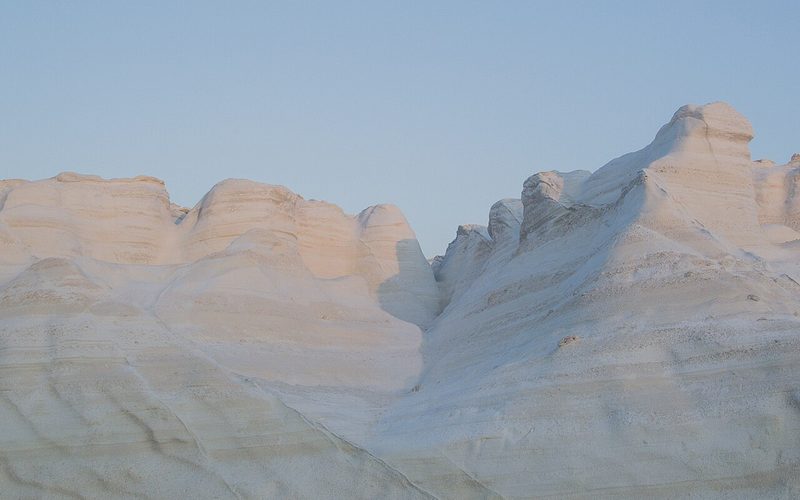
Sarakiniko is a volcanic tuff formation on the north coast of Milos, 10 kilometers from Adamas. White rounded rock masses reaching 3 to 6 meters high create a lunar landscape above shallow turquoise swimming pools. Over 2,000 visitors arrive daily in peak summer.
The white formation is compressed volcanic ash (ignimbrite) deposited during eruptions millions of years ago, then shaped by wind and wave erosion over millennia. Sarakiniko has no organized facilities — no sun loungers, no beach bar, no parking fee. Access is by car or scooter on a paved road; the final 200 meters are on foot. Swimming happens in three natural pools carved between the rocks. Sandals with grip are essential because the tuff surface is smooth and slippery when wet. Sunrise visits (before 7:00) and late-afternoon visits (after 18:00) avoid the midday crowds. The formation also contains sea caves accessible by boat from the eastern end.
How Many Beaches Does Milos Have?
Milos has more than 70 named beaches along 126 kilometers of coastline. White tuff, red volcanic rock, black basalt, golden sand, and multi-colored pebble beaches all appear within the same 160 km² island — no other Cycladic island of comparable size matches this variety.
The 7 beaches consistently rated highest by visitors are:
- Swim at Sarakiniko for white tuff rocks and natural pools on the north coast.
- Access Tsigrado by descending a 50-step iron ladder into a hidden cove on the south coast.
- Reach Fyriplaka by boat or rough road to find gold sand and geothermally warmed water at 28°C.
- Swim at Papafragas through a narrow sea-cave entrance into an emerald lagoon.
- Relax at Achivadolimni, the island’s longest sandy beach, with shallow water safe for children.
- Anchor at Kleftiko by boat to explore sea caves and dramatic basalt arches on the southwest coast.
- Organize a day at Paleochori for a beach bar, restaurant, and geothermal hot springs rising through the sand.
Beaches without vehicle access — Fyriplaka, Tsigrado, Kleftiko — require a boat. Daily boat trips from Adamas cover 5 to 7 beaches in 8 hours and cost 35 to 55 euros per person.
What Is the Geology Behind Milos Beaches?
Milos beaches derive their color from the volcanic minerals in the underlying rock: white from ignimbrite (compressed ash), red from iron-rich basalt, black from obsidian flows, yellow from sulfur-stained tuff, and green from chlorite-rich sediments. Each beach represents a different eruption episode.
The island straddles the Hellenic Volcanic Arc, a chain of volcanic islands stretching from Methana to Nisyros. Milos’s last major eruption occurred 90,000 years ago. Geothermal vents remain active at Paleochori, Katsamos, and Adamas harbor, where underwater hot springs raise sea temperature by 4 to 8°C above ambient. The obsidian at Milos is type SiO2 > 72%, high-quality cutting stone that Neolithic traders shipped to Crete, mainland Greece, and Turkey as early as 11,000 BCE. The Archaeological Museum of Plaka displays obsidian blades from that period alongside other prehistoric finds.
When Is the Best Time to Visit Milos?
May, June, and September are the best months for Milos. Air temperature averages 24 to 30°C, sea temperature reaches 22 to 26°C, and visitor numbers run 40% lower than August. Summer accommodation prices rise 30 to 50% above shoulder season rates.
Monthly breakdown by traveler priority:
- Visit in May for hiking on volcanic trails, wildflower meadows, and empty beaches at 20 to 23°C air temperature.
- Arrive in June for full ferry schedules, all restaurants open, and water temperature reaching 23°C.
- Book September for 20 to 35% lower accommodation prices versus August while retaining full summer services.
- Consider October for photography and geology exploration — geothermal vents are more visible in cooler air.
- Avoid November through March for beach access: most boat-tour operators close and rough Aegean swells limit swimming.
Meltemi winds blow from the north between July and mid-August at 5 to 7 Beaufort on exposed coasts, making north-facing beaches choppy. Sarakiniko and Papafragas face north and become rough during meltemi peaks. South-coast beaches — Fyriplaka, Tsigrado — remain sheltered.
How Many Days Do You Need for Milos?
4 days cover Milos thoroughly: day 1 for Adamas and Plaka, day 2 for the north coast, day 3 for a full boat trip, day 4 for south beaches and the Catacombs. A 5th day adds eastern villages and the Obsidian Museum.
3-night minimum applies for visitors who want both the north (Sarakiniko, Papafragas) and south (Fyriplaka, Kleftiko) coasts plus the Catacombs. Day trips from Santorini or Paros, running 8 to 9 hours, reach only Adamas and Sarakiniko. Day-trippers miss the boat excursion, the Catacombs, and all south-coast beaches. If you plan to pair Milos with Santorini in the same trip, the Santorini complete travel guide covers ferry connections, caldera villages, and accommodation zones so you can sequence both islands efficiently.
Where Should You Stay in Milos?
Adamas suits travelers prioritizing ferry access and central location. Plaka suits those wanting Cycladic architecture and sunset views. Pollonia suits couples seeking a quiet fishing harbor. Trypiti suits visitors focused on the Catacombs and rural seclusion.
Price ranges per night in high season (July–August):
- Book Adamas studios at 70 to 180 euros per night for proximity to the port and beach bus stops.
- Reserve a Plaka Cycladic house at 80 to 220 euros per night for panoramic caldera views and walking distance to the Archaeological Museum.
- Choose Pollonia rooms at 60 to 140 euros per night for a quieter village, fresh fish restaurants, and the Kimolos day-ferry connection.
- Rent Trypiti villas at 100 to 280 euros per night for privacy, olive-grove views, and direct access to the Catacombs site.
August bookings sell out 2 to 3 months in advance across all zones. The local bus serves Adamas–Plaka–Trypiti at 30-minute intervals from 07:00 to 23:00; it does not serve Sarakiniko or south beaches, so vehicle rental remains necessary regardless of accommodation zone.
What Are the Milos Catacombs?
The Milos Catacombs are the largest Early Christian burial complex in Greece, cut into the volcanic hillside at Trypiti in the 1st century CE. The complex holds 126 identified tombs in 5 corridors, with an estimated total of over 8,000 burials.
The site sits 4 kilometers east of Adamas, accessible by local bus or car. Guided tours run daily from 08:00 to 19:30 in summer, every 30 to 45 minutes, costing 4 to 8 euros per adult. Entry without a guide is not permitted. The catacombs were carved from the same volcanic tuff that forms Sarakiniko — soft enough to cut with iron tools, hard enough to hold ceiling arches without structural collapse. The complex was rediscovered in 1840 when a farmer found a collapsed section. 10 meters from the catacomb entrance stands the spot where the Venus de Milo was unearthed in 1820 by farmer Yorgos Kentrotas.
What Happened to the Venus de Milo?
The Venus de Milo is a 2.02-meter marble statue of Aphrodite, discovered near the ancient theater of Milos, purchased by a French naval officer, and transferred to the Louvre in Paris. Milos retains a plaster cast at the Archaeological Museum of Plaka.
Farmer Yorgos Kentrotas found the statue in two fragments inside a niche in an agricultural field. French officer Olivier Voutier sketched the discovery. The local Ottoman administrator sold it to French Ambassador Marquis de Rivière, who presented it to King Louis XVIII. The arms were never found; theories include damage during the 1820 transfer dispute between Greek and French sailors. The Archaeological Museum of Plaka charges 4 euros admission and displays obsidian tools, Neolithic ceramics, and the cast of the Venus alongside other island finds from the Bronze Age through the Byzantine period.
How Do You Get Around Milos?
A scooter at 20 to 30 euros per day covers north and central Milos routes. A car at 40 to 65 euros per day reaches all 70+ beaches. The local bus runs Adamas–Plaka–Trypiti for 1.80 euros but skips remote beaches.
The road network reaches 70% of named beaches with paved access. The remaining 30% — Fyriplaka, Tsigrado, Kleftiko — require a boat or high-clearance 4×4. ATV rentals cost 35 to 50 euros per day. Taxis from Adamas port to Plaka cost 10 euros fixed rate. The Adamas–Pollonia ferry to Kimolos runs 3 to 4 times daily in 15 minutes for 3 euros.
Island driving strategy on Milos differs from loop-road islands. The Lefkada by car driver’s map shows how a single coastal circuit unlocks an entire Ionian island in one day. Milos requires targeted routing by coast direction because north-facing and south-facing beaches suit opposite travel days.
What Does Milos Cost Per Day?
Budget travelers spend 90 to 120 euros per day (hostel, taverna meals, scooter). Mid-range travelers spend 160 to 220 euros with a private studio and car rental. Luxury options — caldera villas and private charters — reach 350 to 600 euros per day.
The 5 largest variable costs on Milos:
- Pay 20 to 30 euros per day for scooter rental, the minimum transport for beach access.
- Budget 35 to 55 euros per person for the full-day boat trip covering 6 beaches including Kleftiko and Fyriplaka.
- Spend 15 to 30 euros per person for a sit-down taverna dinner with fresh grilled fish.
- Reserve 4 to 8 euros per person for Catacombs guided tour entry, the only charged cultural site on the island.
- Allocate 0 euros for beach access — Milos has no beach entrance fees on any of its 70+ beaches.
September prices fall 20 to 30% below August for accommodation. Ferry prices stay fixed year-round; only fast-ferry surcharges vary. For a cost comparison with the best-known Cycladic destination, the guide to the best things to do in Santorini details how Santorini daily costs typically run 40 to 60% higher than Milos for equivalent accommodation standards.
What Food Is Milos Known For?
Milos is known for 4 local specialties: pitarakia (fried cheese pies), revythokeftedes (chickpea fritters), fresh harbor octopus, and xerotigana (honey-dipped dough spirals). Volcanic soil produces the island’s sweet tomatoes and capers used in nearly every taverna salad.
Adamas harbor has 8 tavernas serving fresh fish and seafood. Plaka has 6 restaurants with caldera views — dinner there costs 5 to 10 euros more per person than harbor-side alternatives. Pollonia specializes in fish caught the same morning: bream, red mullet, and sea bass priced by kilogram (18 to 28 euros per kg). The caper plant grows wild on volcanic rock walls across the island; Milos capers are pickled and sold at the local cooperative shop in Adamas for 4 to 7 euros per jar. Pitarakia are available at bakeries in Plaka from 07:00 daily; one costs 2 to 3 euros.
What Are the Top Experiences Beyond Beaches?
Milos offers 6 non-beach experiences: the Catacombs at Trypiti, the Archaeological Museum in Plaka, the Mining Museum in Adamas, the Venetian Castle ruins, the obsidian Nychia headland, and the Kimolos ferry crossing — a second volcanic island 15 minutes away.
The Mining Museum in Adamas documents how Milos supplied bentonite, perlite, and kaolin to European industry throughout the 20th century. Milos remains one of Europe’s largest exporters of perlite — a volcanic glass used in construction and horticulture. The museum charges 3 euros admission and displays original mining equipment, geological cross-sections, and export maps. The Venetian Castle at Plaka dates to the 13th century CE; the outer walls are intact, giving a 270-degree view of the caldera. The Nychia headland, 3 kilometers east of Sarakiniko, exposes the island’s obsidian veins on the surface — no excavation required to see the glassy black volcanic glass.
How Does Milos Compare to Other Cycladic Islands?
Milos has more beach variety than Paros or Naxos, lower prices than Santorini or Mykonos, and fewer tourists: roughly 150,000 visitors per year versus Santorini’s 3 million. It is among the Cyclades’ most distinctive yet least-overcrowded islands.
Key differences across 5 dimensions:
- Choose Milos over Santorini for beach diversity and 40% lower average accommodation cost per night.
- Choose Milos over Mykonos for volcanic geology, cultural sites, and absence of mega-clubs.
- Choose Milos over Paros if volcanic rock formations interest you more than long sandy beaches.
- Choose Milos over Naxos if ferry frequency from Piraeus (daily year-round) is a priority — Naxos has more ferries but less geological uniqueness.
- Choose Milos over Ios for travelers who want history (Catacombs, Archaeological Museum) alongside beaches.
The Santorini unveiled complete guide covers the caldera, wine villages, and Oia sunset logistics in detail for travelers who want to compare both Cycladic options before deciding.
What Is the Kleftiko Sea Cave in Milos?
Kleftiko is a cluster of white volcanic arches, sea caves, and underwater tunnels on the southwest coast of Milos, reachable only by boat. It served historically as a pirate shelter and is now the signature stop of every Adamas boat tour.
The name Kleftiko means “thieves’ cove” in Greek. The formation consists of ignimbrite arches up to 15 meters high carved by wave erosion over thousands of years. Underwater visibility at Kleftiko reaches 25 to 30 meters on calm days, making it one of the clearest snorkeling sites in the Cyclades. Boat tours stop for 45 to 90 minutes; snorkeling equipment is included in the ticket price on most tours. No independent vehicle access exists — the nearest coastal road ends 4 kilometers north. A private water taxi from Adamas to Kleftiko costs 80 to 120 euros return for groups up to 6 passengers.
What Ancient History Does Milos Have?
Milos has 11,000 years of continuous habitation. Obsidian trade made it the Aegean’s first commercial hub in the Mesolithic period. The ancient city of Phylakopi, occupied from 3600 BCE through 1100 BCE, holds one of the longest Bronze Age sequences in the Cyclades.
Phylakopi on the north coast shows 3 distinct settlement layers — Phylakopi I (Early Cycladic, 3600–late 3rd millennium BCE), Phylakopi II (Middle Cycladic), and Phylakopi III (Late Cycladic, through 1100 BCE) — each with different pottery styles and building layouts. The site is open but unexcavated in full; the British School at Athens conducted the original excavations between 1896 and 1899. Milos also appears in the “Melian Dialogue” by Thucydides (Book V), recording the 416 BCE Athenian ultimatum to the neutral Melians during the Peloponnesian War. Athens destroyed the city and enslaved its population after the Melians refused to surrender.
What Local Festivals Take Place on Milos?
Milos holds 3 main annual festivals: the Feast of the Dormition on August 15 at Panagia Evangelistria in Plaka, the Milos Film Festival in September, and the Apokries (Carnival) in February with masquerade parades in Adamas.
The August 15 feast draws worshippers from across the Cyclades. Panigiri celebrations begin on August 14 evening with music, food stalls, and dancing in Plaka’s main square. The Milos Film Festival screens international short films outdoors at various locations including Sarakiniko at night. The Carnival in February coincides with the Greek Orthodox Apokries period; Milos villages hold masquerade parades and satirical floats on the Sunday before Lent begins.
What Wildlife and Nature Exist on Milos?
Milos hosts the Milos viper (Macrovipera schweizeri), one of Europe’s rarest snakes, endemic to the Milos island group. Mediterranean monk seals shelter in coastal caves, flamingos appear at the Alykes salt flats, and over 200 plant species grow on the volcanic soil.
The Milos viper is protected under Greek and EU law; population estimates run between 1,000 and 2,000 individuals. The snake is non-aggressive but venomous; encounters occur on rocky terrain away from organized beaches. The Alykes salt flats, 3 kilometers south of Adamas, attract flamingos in autumn (October–November) when the pans flood. Mediterranean monk seal sightings occur at Kleftiko, Papafragas, and Aggeria cave; the Hellenic Society for the Study and Protection of the Monk Seal (MOm) operates monitoring programs on the island. Milos also retains chameleon populations (Chamaeleo africanus) in the southern scrubland — one of only two Greek islands where the species is established.
Is Milos Good for Snorkeling and Diving?
Milos has 8 designated diving sites with visibility averaging 20 to 30 meters and water reaching 27°C in summer. Sea-cave systems at Kleftiko, Papafragas, and Sikia create unique underwater arches. Three licensed dive centers operate from Adamas and Pollonia.
The 3 top dive sites by difficulty and feature:
- Dive Kleftiko (beginner, 5–15m depth) for ignimbrite arches, sea caves, and Mediterranean grouper schools.
- Dive Glaronissia (intermediate, 10–25m) for basalt columns resembling the Giant’s Causeway rising from 25-meter depth.
- Dive Empourios (advanced, 15–35m) for ancient Roman amphorae scattered on the seabed near the sunken harbor.
All 3 dive centers offer PADI certification courses starting from 350 euros for Open Water. Snorkeling from shore is excellent at Sarakiniko, Papafragas, and Paleochori. Underwater cameras are available for rent at all dive centers for 15 to 20 euros per dive.
What Hiking Trails Does Milos Offer?
Milos has 9 marked hiking trails totaling 65 kilometers, from the 1.5 km Sarakiniko coastal path to the 12 km summit route to Profitis Ilias (751m). All routes use red-and-white waymarkers; the trail map costs 2 euros at the Adamas tourist office.
3 trails stand out for distinct volcanic terrain:
- Walk the Klima Fishermen’s Village trail (3 km, 1 hour) from Plaka to the syrmata boat garages painted in primary colors on the water’s edge.
- Hike the Profitis Ilias summit trail (12 km, 4 hours round-trip) from Triovassalos for panoramic views of the caldera and surrounding islands.
- Follow the Neolithic Obsidian Trail (5 km, 2 hours) from Nychia headland along the original trading path to obsidian outcrops.
Spring (April–May) provides the best hiking conditions: wildflowers cover the volcanic slopes, temperature stays below 25°C, and trail surfaces dry after winter rain. Summer hiking requires a 05:00–09:00 start window before heat exceeds 35°C on exposed ridges.
What Are the Syrmata Fishing Huts of Milos?
Syrmata are two-story boathouses carved into volcanic rock at Klima, Fourkovouni, and Mandrakia along the Milos shoreline. The ground floor holds one fishing boat; the upper floor serves as a seasonal sleeping quarter for the fisherman.
Klima village, below Plaka, contains 36 syrmata in active use. The structures date from the 18th and 19th centuries; their facades are painted in bright red, blue, green, and yellow to distinguish individual fishermen’s property. The color-coding predates formal property registration on the island. Klima is accessible by a steep footpath from Plaka (15 minutes) or by the coastal road from Adamas. Sunrise visits to Klima offer the iconic composition of colored syrmata with the volcanic bay behind — one of the most reproduced photographs of the Cyclades.
How Do You Plan a Milos Boat Tour?
Milos boat tours depart Adamas at 09:00 daily from May through October. Standard tours last 8 hours, cover 5 to 7 beaches, and include Kleftiko and Fyriplaka. Shared tours cost 35 to 55 euros; private charters run 300 to 600 euros per day.
Booking 2 to 3 days in advance is necessary in July and August when tours sell out. Operators include Captain Odysseas, Thalassitra, and Punta Water Sports — all depart from Adamas central quay. Each tour includes snorkeling stops, freshwater rinse, and lunch break at a sea cave or sheltered bay. Children under 5 travel free on all shared tours. Weather cancellations occur when Beaufort force exceeds 5 on the route; full refunds are standard. The optimal booking window for guaranteed calm seas is June and September when meltemi wind frequency drops below 30% of days.
Frequently Asked Questions About Milos
How far is Milos from Santorini by ferry?
Milos is 2.5 to 3.5 hours from Santorini by fast ferry, depending on operator and route. Seajets operates a direct Milos–Santorini route 3 to 5 times per week in summer. The distance is 95 nautical miles. Tickets cost 45 to 65 euros one way. The ferry connects both islands without transiting Piraeus, making the Milos–Santorini combination one of the most efficient two-island itineraries in the Cyclades.
Is Milos crowded in summer?
Milos receives roughly 150,000 visitors per year. Sarakiniko reaches 2,000 visitors per day in August, causing congestion at this single site. Other beaches — Tsigrado, Aggeria, Plathiena — remain uncrowded even in peak season. The island does not have cruise-ship infrastructure, so it avoids the hourly-crowd surges that affect Santorini and Mykonos. Overall, Milos is significantly less crowded than Santorini or Mykonos at equivalent summer dates.
Can you visit Milos in winter?
Milos stays open year-round. The permanent population of 5,200 residents supports grocery stores, pharmacies, and medical services throughout winter. Ferry service from Piraeus continues weekly from November through April, typically 3 to 4 departures per week. Most hotels and restaurants close from November through March. The Catacombs, Archaeological Museum, and Mining Museum stay open year-round. Winter temperatures average 12 to 16°C with rain from November through February.
What language is spoken on Milos?
Greek is the primary language on Milos. English is widely spoken in hotels, restaurants, ferry offices, and tourist-oriented businesses in Adamas and Plaka from May through October. Outside tourist season, English proficiency drops significantly in village shops and local tavernas. French and German are understood by a small number of older residents. Written signage at the Catacombs and Archaeological Museum appears in Greek and English.
Does Milos have an ATM?
Milos has 4 ATMs: 2 in Adamas (one at Alpha Bank, one at Piraeus Bank), 1 in Plaka, and 1 in Pollonia. All accept Visa, Mastercard, and Maestro. Transaction fees average 2 to 4 euros per withdrawal. Card acceptance is high in hotels and larger restaurants; smaller beach tavernas, boat operators, and parking areas operate cash-only. Withdraw cash in Adamas before traveling to remote parts of the island.
Read more
Visit id-agora.com for more travel and SEO guides: