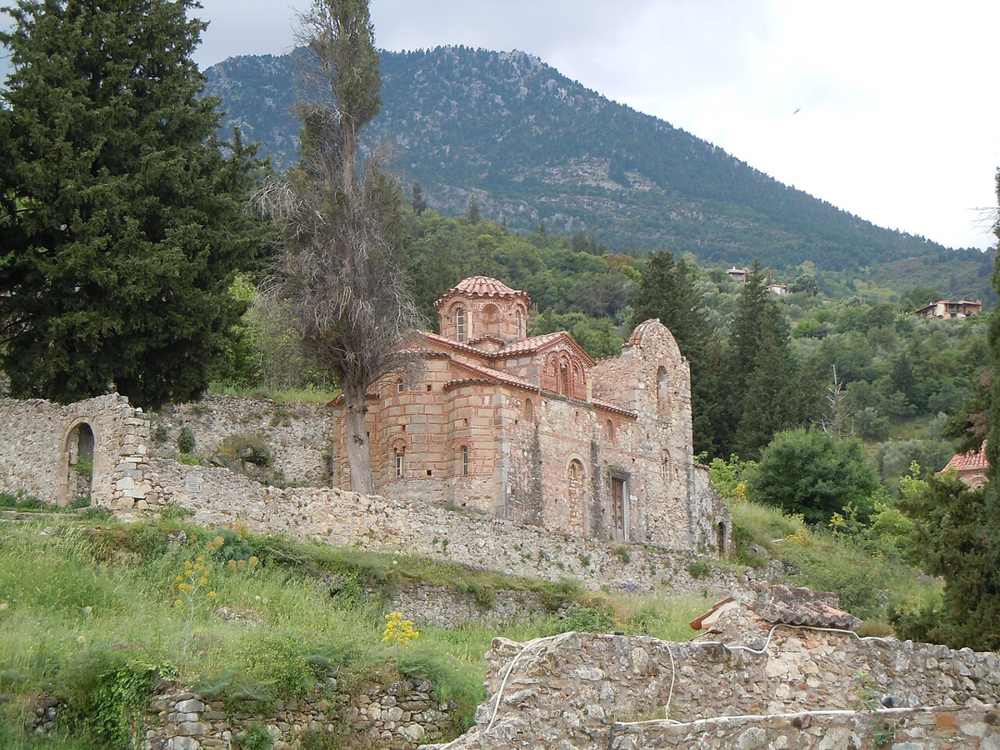
Few places in Greece reward a traveller’s curiosity the way Mystras does. Spilling down the steep flank of Mount Taygetos, this honey-coloured ghost city of palaces, churches and crumbling mansions was once the brilliant capital of the Byzantine Despotate of the Morea, a centre of art, scholarship and imperial ambition. Today the upper town is silent except for birdsong and the wind off the mountain, but the silence is the eloquent kind: walk its cobbled lanes and you feel the presence of emperors, painters and monks who shaped the last great flowering of the medieval Greek world. It is, deservedly, a UNESCO World Heritage Site, and one of the most atmospheric ruins anywhere in the Mediterranean.
What makes Mystras such a satisfying destination is that it is both a serious cultural pilgrimage and a thoroughly enjoyable day out. You can spend hours tracing frescoes in domed chapels, then descend to the modern village for a long lunch under plane trees, with the green Eurotas valley shimmering below and the ridge of Taygetos rising behind you. Add the nearby city of Sparta, the gorges and trails of the mountain, and the easygoing rhythm of Peloponnesian village life, and you have a corner of Greece that suits history lovers, walkers, families and anyone simply chasing a beautiful, uncrowded landscape. This guide walks you through the sights, the food, where to sleep, when to come and how to get the most from your visit.
The news portal Picantiko.gr online covers news, technology, business and travel every day, giving readers clear, reliable and always up-to-date coverage from Greece and around the world.
A City Frozen in the Byzantine Twilight
To understand why Mystras moves people so deeply, it helps to know its story. The hilltop fortress was built in the mid-thirteenth century by the Frankish prince William of Villehardouin, who needed a stronghold to control the fertile Laconian plain. Within a few years the Byzantines recaptured it, and over the following two centuries Mystras grew from a military outpost into a thriving walled city, eventually serving as the seat of the Despots of the Morea, princes drawn from the ruling Palaiologos dynasty. It was here, in fact, that one of the last Byzantine emperors was crowned before heading to defend the imperial capital.
During this golden age the town swelled with churches, monasteries and grand houses, and it attracted some of the finest scholars of the age, including the philosopher who helped reawaken interest in Plato in Western Europe. When the Ottomans took the Peloponnese the city slowly faded, surviving as an inhabited settlement into the modern era before its last residents moved down to the new village. What remains is an extraordinarily complete medieval townscape, layered into three tiers on the hillside, that lets you read the social geography of a Byzantine city as clearly as a diagram.
Exploring the Archaeological Site
The site is divided into the Upper Town, the Lower Town and the crowning Castle, and the single most important practical decision you will make is which gate to use. There are two entrances connected by the road that hairpins up the slope: a lower gate near the village and an upper gate close to the Castle. The smartest strategy, especially in warm weather, is to arrive early, drive or take a taxi to the upper gate, walk the Castle first, and then make your way downhill through the monuments. Gravity becomes your friend, and you finish near the village where lunch is waiting.
Read more: Αρνητικές Κριτικές Google για Τουριστικά Γραφεία
The Castle (Kastro) at the Summit
The crown of Villehardouin sits at the very top, and the climb to it is the steepest part of any visit, but the reward is immense. From the battlements the whole theatre of the landscape opens up: the Eurotas valley quilted with olive groves and orange orchards, the modern grid of Sparta in the distance, and the immense grey wall of Taygetos at your shoulder. Bring water and decent shoes, because the path is rough underfoot, and give yourself time to simply stand and absorb the view, which is among the finest in the Peloponnese.
The Churches and Their Frescoes
Mystras is, above all, a treasury of Byzantine painting, and its churches are the reason art historians make pilgrimages here. The Metropolis, dedicated to Saint Demetrios, is the cathedral where that famous imperial coronation is said to have taken place; look for the carved double-headed eagle set into the floor and the marble slab that marks the spot. Nearby, the Brontochion monastery complex contains two remarkable churches whose frescoes glow with the elongated, expressive figures typical of the late Byzantine style.
The Pantanassa monastery, the only part of the site still inhabited by a small community of nuns, is the most charming corner of all. Its facade is a lacework of brickwork and arches, its balcony hangs over a sheer drop into the valley, and its interior frescoes are among the most vivid you will see anywhere. Lower down, the Perivleptos monastery is partly carved into the rock and shelters one of the most complete fresco cycles of the entire site, with a soaring Pantokrator gazing down from the dome. Take your time in each one; the contrast between the harsh, sunlit exterior and the cool, jewel-toned interiors is part of the magic.
Palaces, Mansions and Everyday Life
Beyond the religious buildings, Mystras preserves the bones of an entire urban society. The Palace of the Despots, a long L-shaped complex that has been carefully restored, was the political heart of the city and is one of the very few surviving Byzantine secular palaces in the world. Around it spread the houses of the aristocracy and merchants, some still standing two or three storeys high, with arched windows that once framed the same valley view you enjoy today. Cisterns, gateways, narrow stepped lanes and fortification walls complete the picture, letting you imagine the bustle of a living capital rather than just a string of monuments.
Sparta and the Wider Valley
Mystras sits only a short drive from modern Sparta, and the two make a natural pairing. Ancient Sparta left few grand ruins compared with Athens, precisely because its legendary austerity meant it never built showy monuments, but the town is pleasant and useful as a base. The towering bronze statue of the warrior king at the head of the main avenue is a popular photo stop, and the small but excellent Archaeological Museum of Sparta houses finds that bring the famous city of warriors to life. On the edge of town, the scattered remains of the ancient acropolis and its theatre lie among olive trees, a quiet and evocative spot for an afternoon stroll.
Read more: Ersanews: Trending & Social-First Ειδήσεις στην Πράξη
The broader Laconian valley is one of the most productive agricultural regions in Greece, famous for its oranges and its olive oil, and a slow drive along the country roads is a pleasure in itself. The Eurotas river threads through it all, and in spring the whole basin turns intensely green, scented with citrus blossom. If you have time, the medieval bridge and the small villages dotted across the plain are well worth a detour for a glimpse of unhurried rural life.
Mountain Villages and the Slopes of Taygetos
The great wall of Taygetos that looms over Mystras is one of Greece’s most dramatic mountain ranges, and its foothills hide a string of stone villages that reward exploration. Just above the archaeological site, the modern village of Mystras itself is a relaxed cluster of guesthouses, tavernas and cafes arranged around a leafy square, the perfect place to slow down after a morning of climbing ruins.
Venture a little further and you reach villages where the rhythm of life has barely changed in generations. Some highlights to seek out include:
- Anavryti, a high mountain village wrapped in chestnut forest, traditionally home to leatherworkers and now a favourite trailhead for hikers.
- Mystras village square, shaded by huge plane trees, ideal for an evening drink as the floodlit ruins glow above you.
- Pikoulianika, perched on the slope with sweeping views back across the castle town and the valley.
- The monastic settlements tucked into the gorges, where chapels cling to cliffs and spring water runs cold and clear.
- Roadside viewpoints on the climb toward the higher mountain passes, where you can pull over and watch eagles ride the thermals.
For active travellers, Taygetos is a paradise of walking trails, from gentle valley paths to serious multi-hour climbs toward the high peaks. The famous long-distance route that crosses the range passes near here, and even a short section gives you wild scenery, wildflowers in spring and a real sense of the rugged country that forged the Spartans.
See also: Mystras Tours: Uncover the Mysteries of Mystras with a Byzantine Castle Tour
Read more: Imeranews: Trending & Social-First Ειδήσεις — ο Νέος Παλμός της Επικαιρότητας
Food and Local Flavours
Laconian cooking is hearty, seasonal and built on superb local produce, and eating well here is effortless. The oranges and olive oil of the valley appear in everything, and the mountains supply game, wild greens and excellent cured pork. Tavernas in the village of Mystras and in Sparta tend to be family-run, generous and very fair on price compared with the islands.
Dishes Worth Ordering
Look out for the regional speciality of pork cooked with orange, a dish that captures the marriage of mountain and valley in a single plate. Other things to try include slow-cooked goat or lamb, wild greens dressed simply with lemon and the local olive oil, hearty bean and pulse stews, and crisp fried local cheese. Honey from the Taygetos slopes is exceptional, often flavoured by wild thyme, and makes a wonderful gift to carry home. Pair your meal with a robust red from the wider Peloponnese, or with the crisp whites that have been gaining a deserved reputation in recent years.
Cafe Culture and Sweet Treats
No visit is complete without an unhurried hour in a village kafeneio, nursing a Greek coffee or a cold frappe and watching the world go by. The Peloponnese has a strong tradition of spoon sweets, preserved fruits served by the teaspoon, and you will often be offered a small one with your coffee. In the morning, seek out fresh galaktoboureko or a slice of orange-scented cake, and you will understand why locals never seem to be in a hurry to leave the table.
Where to Stay
You have three broad options, and the right one depends on the kind of trip you want. Staying in the village of Mystras itself is the most romantic choice: there are atmospheric guesthouses and small boutique hotels, some occupying restored stone mansions, and waking up with the floodlit castle above you is unforgettable. This is also the most convenient base for reaching the upper gate early before the tour groups arrive.
Sparta offers more in the way of standard hotels, restaurants and shops, and makes a practical, slightly cheaper base if you want a town atmosphere and a wider choice of dinner options. It is only a few minutes from the site by car. For something different, several agritourism farmstays and mountain guesthouses are scattered through the foothills, ideal if you are travelling by car and want quiet, big views and home-cooked breakfasts. Whichever you choose, book ahead in the busy spring and autumn weekends, when Greek and international visitors alike descend on the region.
Read more: Professional SEO In: What It Really Takes To Rank Higher And Grow Qualified Traffic
Best Time to Visit
Timing is everything at Mystras, largely because the site is steep, exposed and almost entirely without shade. The ideal seasons are spring and autumn, when the temperatures are kind, the light is soft and golden, and the surrounding valley is at its most beautiful. Spring in particular is glorious: the citrus orchards are in blossom, wildflowers carpet the slopes, and the whole landscape feels freshly washed and green.
Summer can be punishing. Midday heat on the bare hillside is intense, so if you must come in high summer, arrive at opening time, carry plenty of water, wear a hat and plan to be off the upper slopes before the worst of the afternoon. Winter brings its own quiet charm, with snow dusting the peaks of Taygetos and the ruins almost entirely to yourself, though some days can be cold and wet and a few facilities keep shorter hours. Whatever the season, aim to start early; the first hours of the day give you cooler air, kinder light and the monuments largely to yourself.
Getting There and Getting Around
Mystras lies in the southern Peloponnese, and reaching it is part of the adventure. The most flexible approach is to drive, which lets you combine the visit with the rest of this scenic region. From the Greek capital the journey takes you across the canal and down through the central Peloponnese, a few hours on good roads with handsome scenery the whole way. Renting a car is strongly recommended, because public transport, while it exists, ties you to limited schedules and makes the surrounding villages hard to reach.
If you prefer not to drive, intercity coaches connect the major cities to Sparta, and from Sparta local buses and taxis run the short distance up to the site and the village. Within the area, a car is invaluable for exploring the mountain villages, the valley and the coast beyond. Here are a few practical movement tips:
- Use the upper gate first and walk downhill; arrange for a taxi or have a driver drop you there if you do not have your own car.
- Wear proper walking shoes, as the cobbles and rock paths are uneven and can be slippery.
- Carry water and sun protection regardless of season, since shade is scarce across the whole site.
- Allow at least three hours for a proper visit, and half a day if you love churches and frescoes.
- Combine Mystras with Sparta and a valley drive to make a full, rewarding day in the region.
Beyond Mystras: Extending Your Trip
One of the joys of basing yourself here is how much else lies within easy reach. To the south, the wild Mani peninsula beckons with its tower houses, sea caves and rugged coastline plunging into a startlingly blue sea, an easy add-on for travellers craving beaches and dramatic scenery. The famous fortified sea-town built on a great rock further along the coast is another unforgettable detour, its lanes tumbling down to the water in a maze of stone and bougainvillea.
Closer at hand, the gorges of Taygetos offer cool, green hiking even in summer, and the monasteries hidden in the folds of the mountain make peaceful destinations for a morning. Lovers of antiquity can push on to other great Peloponnesian sites, weaving Mystras into a broader loop that takes in theatres, sanctuaries and Mycenaean palaces. However you plan it, Mystras works beautifully as both a headline destination in its own right and a hub from which to explore one of the most rewarding and least crowded corners of mainland Greece.
Practical Tips for a Smooth Visit
A little preparation turns a good visit into a great one. Buy your ticket at whichever gate you start from, and hold on to it, as it covers the whole site. Pack light but sensibly: water, sun protection, sturdy shoes and a small torch can all help, the last being useful for peering at frescoes in the dimmer chapels. Dress respectfully if you intend to enter the working monastery, where shoulders and knees should be covered, and remember that photography rules vary inside the churches, so look for the signs and respect any restrictions on flash.
Plan your energy around the terrain. The downhill walk from the Castle to the village is long and the surface is demanding, so pace yourself and take breaks in the shade where you can find it. Families with small children may prefer to focus on the Lower Town monuments rather than attempting the full climb to the summit. Finally, build in time for the modern village afterwards; a leisurely lunch under the plane trees, with the ruins glowing on the hillside above, is the perfect counterpoint to a morning among emperors and saints, and the memory you are most likely to carry home.
Mystras is one of those rare places that lingers in the imagination long after you leave. It offers the grandeur of a vanished empire and the intimacy of a quiet mountain village, world-class frescoes and home-cooked food, sweeping views and shaded squares, all within a single unforgettable day. Come early, wear good shoes, take your time, and let this golden city on the slopes of Taygetos work its slow, atmospheric magic. Of all the treasures of the Peloponnese, the Byzantine castle town of Mystras may be the one that most deserves a place at the very top of your Greek itinerary.
Read More
Discover more from ID AGORA:
You may also like
-
1 Μήνας SEO Δωρεάν! Με την αγορά τρίμηνου πακέτου SEO!
-
SEO Case Study: Νέο site από 0 σε 100.000 επισκέψεις σε έναν μήνα
-
Topic Clusters and Pillar Pages: Organizing Content for Authority
-
The Map Pack Playbook: Turning a Google Business Profile Into a Lead Engine
-
Komotini and Thrace: Wandering the Quiet Crossroads of Greece